Certified Lab Grown Diamond Supplier UAE: What B2B Buyers Should Check
The UAE’s lab-grown diamond trade just had its biggest year on record. Volumes hit 76.9 million carats in 2025, up 91.5% year-on-year, and Dubai’s DMCC has now launched a dedicated Lab-Grown Diamond Vertical to keep pace with the growth, treating lab-grown as its own category rather than an offshoot of the natural diamond trade. For jewellery brands and retailers sourcing stock, that expansion is good news, but it also means more suppliers competing for the same orders, and not all of their “certified” claims hold up the same way. Before signing a purchase order, a certified lab grown diamond supplier UAE buyers can actually rely on needs to show paperwork that survives scrutiny, not just a certificate logo on an invoice.
What “Certified” Should Actually Mean
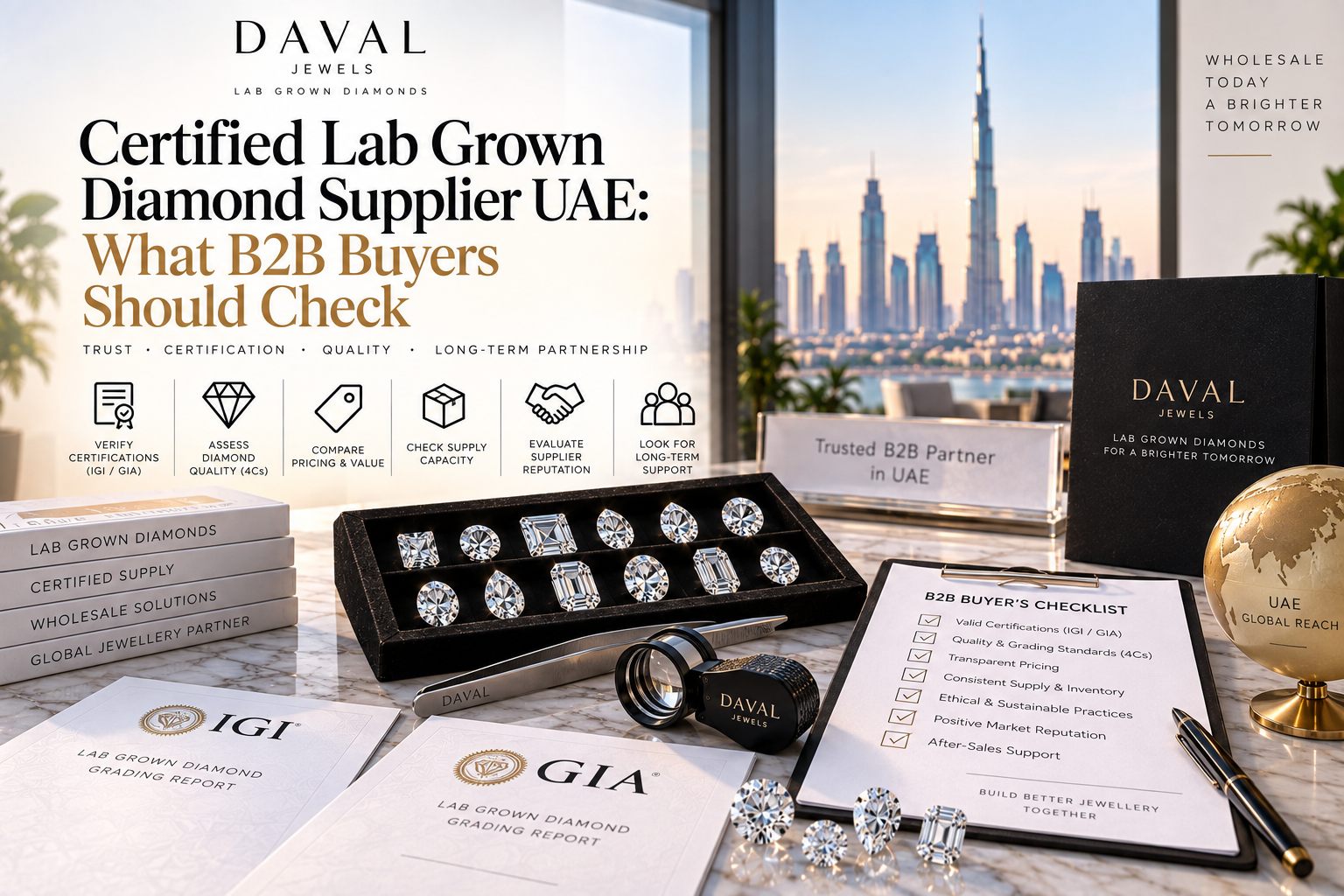
A grading report only means something if it comes from an independent lab with no financial stake in the sale. IGI, for instance, is accredited to ISO 17025 for both natural and lab-grown diamond grading, the international standard for testing and calibration competence, which is the kind of credential worth asking about if a supplier quotes a lab you don’t recognise. A proper certificate should confirm four things: whether the stone is natural or lab-grown, and if lab-grown, whether it was produced by HPHT or CVD; an assessment of its quality; its exact measurements, polish and symmetry; and a unique report number laser-inscribed on the girdle, so the paperwork can always be matched back to the physical stone.
That last point matters more than buyers often realise. Without a girdle inscription to check, a supplier could show one stone at the counter and ship a different one entirely. Two labs currently handle the large majority of lab-grown diamond grading worldwide, IGI and GIA, and as of last year they no longer describe quality the same way, which is the part most sourcing guides haven’t caught up with yet.
Certified Lab Grown Diamond Supplier UAE: How IGI and GIA Reports Differ in 2026
This is where a lot of buyers get caught out. IGI still grades lab-grown diamonds on the full four Cs, individual colour and clarity grades, a cut grade for round stones, plus polish and symmetry, the same detailed framework it applies to natural diamonds. Its reports also now state plainly whether a stone shows any sign of post-growth treatment, or whether it’s “as grown.”
GIA took a different route. Since October 2025, it no longer issues individual colour and clarity grades for D-to-Z lab-grown diamonds at all. Instead, it sorts them into just two tiers, Premium or Standard, based on an overall read of colour, clarity and finish, and any stone that doesn’t clear the minimum bar simply isn’t graded. A separate Belgian lab, HRD Antwerp, went further still and stopped certifying loose lab-grown diamonds entirely, choosing to draw a hard line between natural and synthetic stones instead.
None of this makes one lab more legitimate than another; both IGI and GIA remain accredited, independent graders. But it does mean a “GIA-certified” parcel bought today carries less granular detail than one bought two years ago, and a buyer comparing a GIA Premium stone against an IGI-graded one needs to recognise they’re reading two different scales, not the same scale from two sources.
Why This Matters More on Wholesale Orders
A retail shopper choosing a single engagement-ring stone can live with some ambiguity in the grading language; they’re evaluating one diamond in front of them. A jewellery brand placing a bulk order for a new collection can’t do that at scale. If a supplier ships fifty stones described only as “GIA Premium,” a buyer has no way to confirm they’re matched to each other on colour and clarity, because that tier only confirms they all cleared the same floor. It doesn’t say which side of it each stone sits on, or whether one is noticeably warmer than another once they’re set side by side in a display case.
IGI’s per-stone 4Cs grading gives a buyer the exact colour and clarity codes needed to sort and match inventory consistently across a production run, which is part of why the large majority of the world’s lab-grown diamond certification still runs through IGI rather than GIA today. Neither lab is the wrong choice, and a GIA Premium stone can be an excellent diamond. But this is exactly the kind of detail that separates a certified lab grown diamond supplier UAE wholesalers can build a repeat order pipeline with from one that’s simply attaching paperwork to a sale.
How to Verify a Certificate Before You Commit
Checking a report takes a couple of minutes and should be routine on every order, not just the first one. Start with the report number printed on the document, then look it up on the issuing lab’s own free database, IGI’s Report Verification tool or GIA’s Report Check, and compare every field on screen against the paper copy: shape, measurements, carat weight and the quality assessment itself. Then ask to see the girdle inscription under 10x magnification and confirm the same number is etched into the stone. A supplier who hesitates to let a buyer carry out either check in person, or over video for a remote order, is worth walking away from.
This is also where working with an established, in-market supplier simplifies things. Daval Jewels runs B2B and wholesale diamond supply for jewellery brands and retailers across the UAE from its Gold Souk showroom in Deira, so buyers can check girdle inscriptions against IGI and GIA reports in person before stock ever leaves the building, rather than relying on photos or a courier.
A Quick Checklist for B2B Buyers
Before finalising a purchase order, confirm:
- Which lab graded the stones, and whether that matters for the order size: IGI’s per-stone 4Cs or GIA’s Premium/Standard tiers
- That every report number has been checked against the issuing lab’s own database, not just the supplier’s invoice
- That the girdle inscription has been verified under magnification, ideally before stock leaves the supplier’s premises
- That batch certificates, where used, list each stone individually rather than as an averaged lot description
- That the supplier can document the growth method (HPHT or CVD) and disclose any post-growth treatment, since both affect resale value
A certified lab grown diamond supplier UAE buyers return to repeatedly is one that treats these checks as routine, not as an inconvenience.
Frequently Asked Questions
Do IGI and GIA both certify lab-grown diamonds sold in the UAE?
Yes. Both are internationally accredited, independent labs, and either name on a report is legitimate. The difference is in what the report says: IGI still grades on the full 4Cs, while GIA now classifies stones as Premium or Standard only.
Did GIA stop using the 4Cs for lab-grown diamonds?
Yes, as of October 2025. GIA replaced individual colour and clarity grades for D-to-Z lab-grown diamonds with a two-tier Premium/Standard classification based on overall quality.
How can I check that a lab-grown diamond certificate is genuine?
Look up the report number on the issuing lab's free online database and compare every field to the paper certificate, then confirm the same number is laser-inscribed on the stone's girdle under magnification.
Why does certification detail matter more for wholesale buyers than individual shoppers?
A bulk order needs stones that are consistently matched for colour and clarity. A single-tier grade like GIA's Premium/Standard confirms a quality floor but not a precise match, which is why IGI's per-stone 4Cs are easier to sort and resell against.
Does a certificate confirm ethical sourcing as well as quality?
No. A grading report verifies a stone's physical characteristics and origin, natural or lab-grown, not its supply chain. Ethical sourcing claims should be confirmed separately with the supplier.
Related posts
Local Lab Grown Diamond Supplier UAE: Why Proximity Pays Off for Buyers
Dubai’s DMCC recently created a dedicated Lab-Grown Diamond Vertical after the UAE’s trade
Lab Grown Diamond Wholesale Sourcing UAE: What Jewellery Businesses Need to Know
The UAE’s lab-grown diamond trade hit a record 76.9 million carats in 2025, up 91.5 percent on
Reliable Lab Grown Diamond Supplier UAE: A Wholesale Buyer’s Verification Checklist
Reliable Lab Grown Diamond Supplier UAE: A Wholesale Buyer’s Verification Checklist The UAE’s
Lab Grown Diamonds Wholesale UAE: The Ultimate Buying Guide
Lab Grown Diamonds Wholesale UAE: The Ultimate Buying Guide The UAE traded a record 76.9 million carats
Lab Grown Diamond Suppliers Dubai: Essential 2026 Guide
Lab Grown Diamond Suppliers Dubai: Why UAE Jewellers Are Making the Switch The UAE traded 76.9 million
B2B Lab Grown Diamond Supplier UAE: A Complete Buying Guide
B2B Lab Grown Diamond Supplier UAE: A Complete Buying Guide UAE lab-grown diamond trade jumped 91.5%
NEW POSTS

September 21, 2026
Certified Lab Grown Diamond Supplier UAE: What B2B Buyers Should Check

September 20, 2026