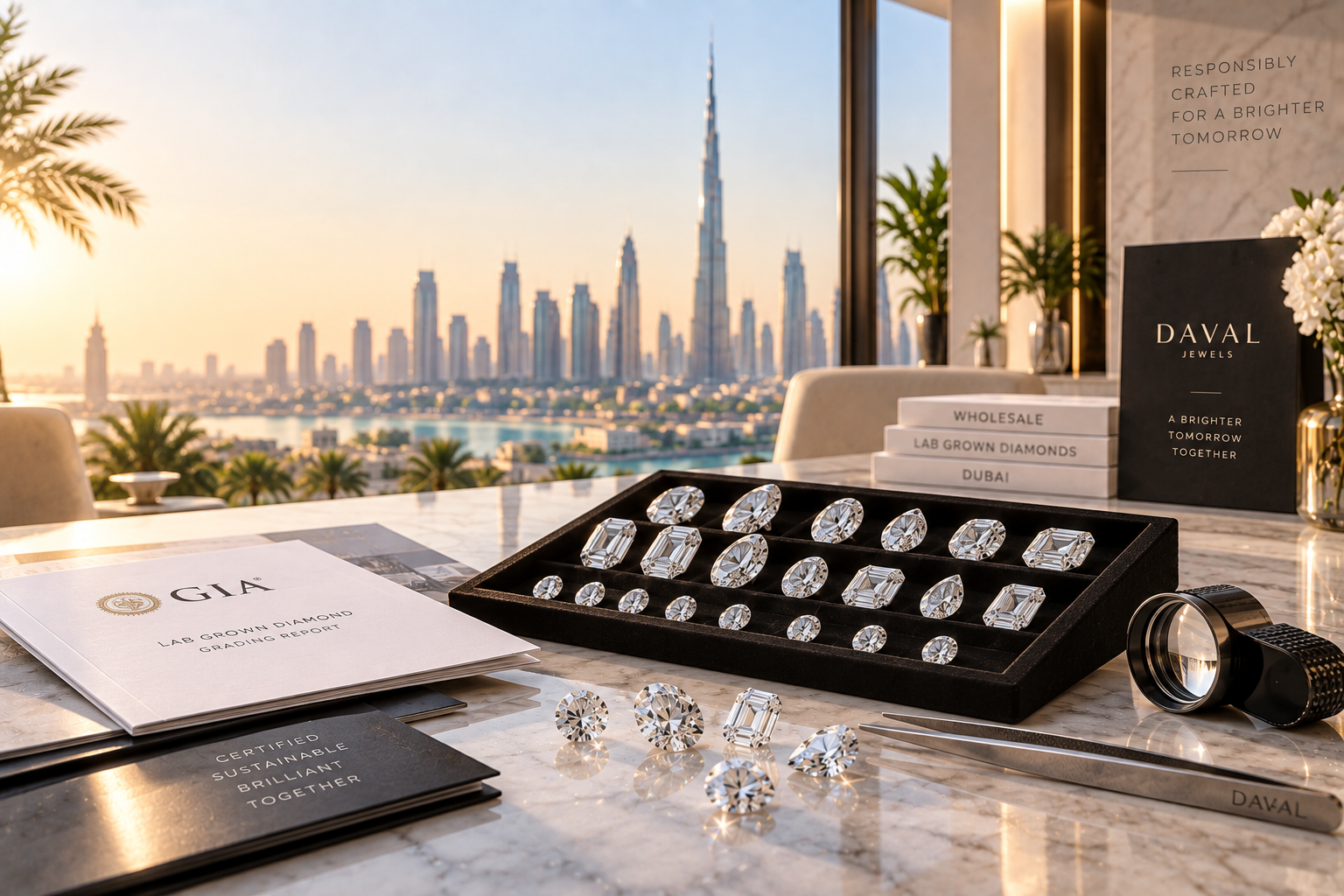
Lab Grown Diamond Suppliers Dubai: Essential 2026 Guide
Lab Grown Diamond Suppliers Dubai: Why UAE Jewellers Are Making the Switch
The UAE traded 76.9 million carats of lab-grown diamonds in 2025 — a jump of roughly 91.5% on the previous year, according to DMCC figures. Volume like that doesn’t come from consumer curiosity alone. It comes from retailers rebuilding their supply chains. Across Deira, the DMCC free zone and the newer boutique districts, the lab grown diamond suppliers Dubai jewellers once treated as a side experiment have quietly become their primary source of stock. Here’s what’s actually driving that shift, and what to check if you’re evaluating a supplier yourself.
The Trade Numbers Behind the Shift
DMCC’s 2025 data puts UAE lab-grown volumes at an all-time high. Trade has more than doubled since 2022, when the figure stood at 36.8 million carats, with imports and re-exports expanding at broadly similar rates.
The more interesting number is the one that didn’t move much. While volume nearly doubled, trade value rose only 7.5%, to about $1.3 billion. Run those two figures against each other and the average value per carat crossing the UAE border fell steeply in a single year — on the order of 40%. For a jeweller writing a purchase order, that means substantially more carats for the same spend.
DMCC has also formally established a Lab-Grown Diamond Vertical, operating separately from its natural diamond and coloured stone activities. The signal for retailers is worth reading properly: this is now treated as its own trade category with its own infrastructure, not an offshoot of the mined market. It sits inside a UAE diamond trade that reached a record $41.7 billion in 2025.
Why UAE Jewellers Are Rethinking Their Diamond Supply
Customer demand has already moved. Industry analysis puts lab-grown centre stones at roughly 61% of US engagement rings by unit in 2025, up from around 12% in 2019. A meaningful share of UAE walk-in traffic — residents and tourists alike — now arrives having already done that research elsewhere.
Working capital goes further. Falling per-carat costs mean a retailer can hold a wider spread of shapes and sizes for the same tied-up cash. A case that previously held six one-carat options can hold twenty, which changes the conversion rate on a walk-in far more than any single stone does.
The margin structure has held up. Tracking of retail pricing suggests that while wholesale lab-grown prices fell sharply — one industry estimate puts the 2025 drop alone at around 26% — retail markups have not compressed at the same rate. Most of that gap has stayed with the retailer.
Customisation gets faster. Holding loose stones locally, rather than ordering finished pieces, lets a workshop turn a bespoke commission around in days. In a market where a customer may be flying out on Thursday, that is often the whole sale.
Lab Grown Diamond Suppliers Dubai: The Certification Shift That Changed Everything
This is the part many retailers haven’t fully priced in yet.
On 1 October 2025, GIA stopped issuing 4Cs colour and clarity grades for lab-grown diamonds. In place of the old report, it now issues a Laboratory-Grown Diamond Quality Assessment that sorts a stone into one of two tiers — Premium or Standard — based on a combined read of colour, clarity and finish. Premium requires D colour and VVS clarity or better. There is a minimum size of 0.15 carats, and stones falling below the threshold receive no assessment at all.
IGI, meanwhile, kept the letter grades. In its 2024 IPO prospectus, IGI estimated it accounted for roughly 65% of the global lab-grown certification market. So the practical difference for a jeweller is now stark: an IGI report still tells a customer exactly what they’re buying, while a GIA document issued after October 2025 tells them which of two broad bands the stone falls into.
That has a direct commercial consequence. If your supplier ships predominantly GIA assessments, your sales staff lose the paperwork they need to justify a price difference between two similar stones. Most UAE wholesale desks have defaulted to IGI for precisely that reason.
One more wrinkle worth knowing: IGI has restructured its own report formats, making the clarity plot and Hearts & Arrows notation optional add-ons. Two IGI certificates for near-identical stones can therefore look quite different, and neither is fraudulent. The grades themselves are unaffected. Don’t assume a plainer-looking certificate signals a lesser stone.
What to Check Before You Commit to a Supplier
The lab grown diamond suppliers Dubai retailers stay with for years tend to share a handful of traits, and none of them are about headline price per carat.
- Inscription-to-paper match. Every lab-grown stone IGI reports on carries an LG prefix laser-inscribed on the girdle ahead of the report number. Check it under 10x magnification and verify the number on the lab’s own database — not on a PDF the supplier emailed you.
- Honest grade bands. Ask what the standing inventory band genuinely is. A supplier quoting DEF/VS and above across every shape is making a very different commitment from one quoting it on rounds only.
- Depth in fancy shapes. Ovals, pears, emeralds and cushions are where reorder gaps hurt, because that’s where a customer has usually set their heart on something specific.
- Matched-stone reorders. For studs, three-stone settings and tennis layouts, the question isn’t whether the supplier has the stone — it’s whether they can find its twin in six months.
- Somewhere you can actually walk in. Approving a stone from a spreadsheet is not the same as pulling it from a parcel under a loupe.
That last point is why many UAE retailers still prefer to source inside the Emirates rather than buying blind from overseas parcels. Daval Jewels, for instance, runs its B2B lab diamond supply for jewellery brands in the UAE out of the Gold Souk district in Deira, holding certified loose inventory that a buyer can inspect in person before it goes anywhere near a customer’s setting.
Where This Leaves the Trade
The shift isn’t really about lab-grown versus mined any more — that argument was settled by customers, not by retailers. It’s about supply discipline. Prices per carat are still drifting downward, certification has fractured into two incompatible systems, and the DMCC has built separate infrastructure around the category.
The lab grown diamond suppliers Dubai jewellers commit to over the next two years will be judged less on their quotes and more on paperwork, shape depth and the ability to repeat an order. Buy to your expected turnover rather than stockpiling, verify every certificate independently, and treat the supplier relationship as something you audit annually rather than set and forget.
Frequently Asked Questions
Are lab-grown diamonds real diamonds?
Yes. They have the same carbon crystal structure, hardness and optical properties as mined stones, and standard testing equipment identifies them as diamond. The differences are origin and the disclosure that must accompany the sale.
Should I stock IGI or GIA certified lab-grown diamonds?
For retail, IGI is the practical choice. Since October 2025 GIA no longer issues 4Cs grades for lab-grown stones, so an IGI report is what gives your customer the colour, clarity and cut detail they expect when comparing two options.
How do I verify a lab-grown diamond certificate?
Read the report number laser-inscribed on the girdle under 10x magnification, then look that number up on the grading laboratory's own verification database. A PDF supplied by the seller is not verification.
Where can I find lab grown diamond suppliers Dubai jewellers trust?
The Gold Souk district in Deira and the DMCC free zone are the two main clusters. Prioritise a supplier holding certified loose inventory on site, so you can inspect stones physically before placing an order.
Is CVD or HPHT better for retail stock?
Neither method is inherently superior for finished jewellery. Both produce gem-quality stones, and the certificate's colour, clarity and cut grades tell you far more about what you're selling than the growth method does.
Will lab-grown wholesale prices keep falling?
Per-carat prices have fallen steeply over several years and the 2025 UAE trade data suggests that trend continued. Plan inventory on the assumption that a stone bought today may cost less to replace next year, which argues for buying to turnover rather than stockpiling.
Related posts
Lab Grown Diamond Wholesale Sourcing UAE: What Jewellery Businesses Need to Know
The UAE’s lab-grown diamond trade hit a record 76.9 million carats in 2025, up 91.5 percent on
Reliable Lab Grown Diamond Supplier UAE: A Wholesale Buyer’s Verification Checklist
Reliable Lab Grown Diamond Supplier UAE: A Wholesale Buyer’s Verification Checklist The UAE’s
Lab Grown Diamonds Wholesale UAE: The Ultimate Buying Guide
Lab Grown Diamonds Wholesale UAE: The Ultimate Buying Guide The UAE traded a record 76.9 million carats
B2B Lab Grown Diamond Supplier UAE: A Complete Buying Guide
B2B Lab Grown Diamond Supplier UAE: A Complete Buying Guide UAE lab-grown diamond trade jumped 91.5%
Lab Grown Diamond Supplier UAE: 10 Things to Check
10 Things to Consider When Choosing a Lab-Grown Diamond Supplier in the UAE Choosing a lab grown diamond
How to Choose the Best Lab Grown Diamond Supplier in UAE
The UAE’s lab-grown diamond trade just hit a record high — volumes surged past 76.9 million carats
NEW POSTS


September 17, 2026
Lab Grown Diamonds Wholesale UAE: The Ultimate Buying Guide

September 16, 2026