How to Choose the Best Lab Grown Diamond Supplier in UAE
The UAE’s lab-grown diamond trade just hit a record high — volumes surged past 76.9 million carats in 2025, up more than 91% year-on-year, with trade value climbing to $1.3 billion. Dubai has even set up a dedicated DMCC Lab-Grown Diamond Vertical to support the industry’s rapid expansion. That growth is great news for buyers, but it also means more suppliers, more price points, and more room for confusion. If you’re trying to find a lab grown diamond supplier UAE shoppers can actually trust, here’s what separates a serious dealer from a stall selling stones with no paperwork behind them.
Why the UAE Is the Right Place to Buy
Dubai isn’t just a convenient shopping stop for diamonds — it’s genuinely become one of the world’s central trading hubs for them. With trade volumes more than doubling since 2022 and re-export activity growing at a similar pace, the city has built serious infrastructure around sourcing, grading, and moving lab-grown stones globally. For a buyer, that translates into wider selection, more competitive pricing than many Western markets, and suppliers who are used to working with both certification bodies and demanding international clients. The catch is that a fast-growing market also attracts sellers who cut corners, so the “where” matters less than the “who.”
What to Check Before You Trust a Lab Grown Diamond Supplier UAE
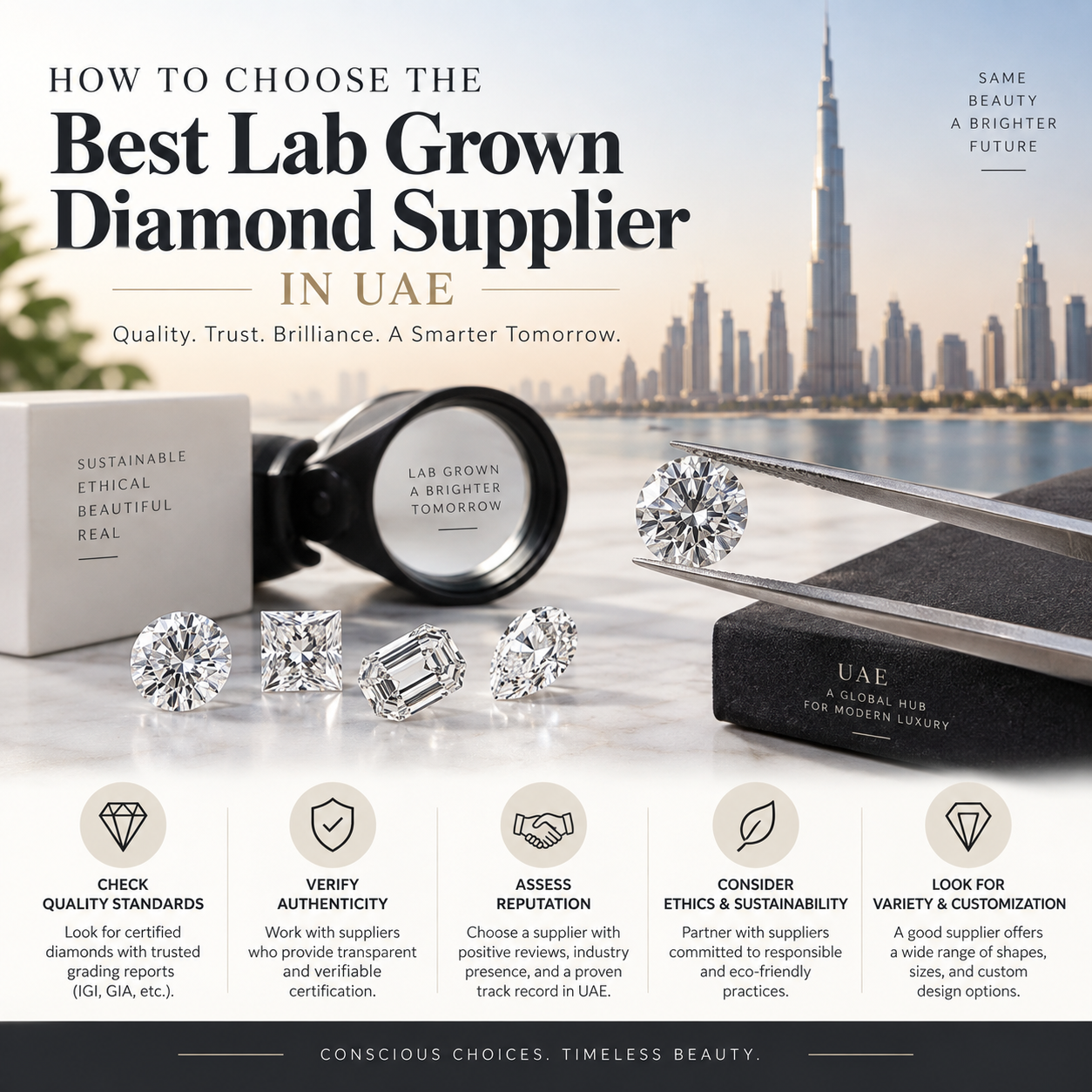
- A trustworthy supplier should make every part of this easy, not something you have to ask twice for.
- Independent certification on every stone. This is non-negotiable. A diamond should come with a report from an internationally recognized lab — most commonly IGI, since it grades the vast majority of lab-grown stones on the market today, though GIA-certified options exist as well. The report should list the growth method (CVD or HPHT), along with full cut, color, clarity, and carat details, and it should be checkable against the lab’s own online verification tool. If a seller can’t show you a report number you can independently verify, walk away.
- Transparency about how the diamond was grown. Reputable suppliers will tell you plainly whether a stone was produced via CVD or HPHT, and won’t be cagey about it. This information should also be printed on the certificate.
- A physical presence, not just a listing. Dubai’s Gold Souk district in Deira has been the traditional heart of the city’s diamond and jewelry trade for decades. Suppliers with an established shop there have a reputation to protect and are typically easier to hold accountable than a purely online seller with no verifiable address.
- Flexibility across the full 4Cs. A good supplier lets you browse and filter by shape, carat, clarity, and color rather than pushing pre-set combinations, so you can match a stone to your actual budget and design instead of settling for whatever’s in stock.
- Support beyond the sale. Ask whether the supplier can set the stone into a custom design, whether they offer sizing and adjustments, and how they handle shipping and warranty. A supplier focused purely on moving loose stones fast, with no aftercare, is a red flag for anyone buying an engagement ring or a piece meant to last.
Buying Loose vs. Buying Wholesale
- Individual buyers and business buyers need different things from a supplier, and it’s worth knowing which category you fall into before you start comparing options.
- If you’re buying a single stone — for an engagement ring, an upgrade, or as a personal investment piece — you want a retailer with a strong loose-diamond catalogue, clear certification on each listing, and the ability to walk you through the trade-offs between cut, color, and clarity for your budget.
- If you’re a jeweler, retailer, or brand sourcing at volume, the priorities shift toward consistency of supply, wholesale pricing structures, and a supplier who can keep pace with repeat orders without quality drifting from batch to batch. This is where working with an established B2B lab-grown diamond supplier in the UAE makes a measurable difference — a partner with over a decade of regional experience can offer the kind of reliable, certified supply chain that a one-off online seller simply isn’t built for.
Common Mistakes Buyers Make
- Assuming “certified” always means the same thing. Certification quality varies by lab. Since GIA changed how it grades lab-grown color and clarity in late 2025, moving to descriptive categories instead of letter grades, the specific report format matters more than it used to — know what you’re reading before you compare prices across sellers.
- Comparing price without comparing the 4Cs. A lower price often means a lower cut or clarity grade, not a better deal.
- Skipping the verification step. Always look up the certificate number on the issuing lab’s own website before finalizing a purchase.
- Ignoring aftercare. Resizing, warranty, and setting options matter just as much as the stone itself.
Frequently Asked Questions
Is a lab-grown diamond as real as a mined one?
Yes. A lab-grown diamond has the same chemical structure, hardness, and optical properties as a mined diamond — the only difference is where it formed. Even professional diamond testers register it as a genuine diamond.
Which certification should I look for on a lab-grown diamond in the UAE?
IGI is the most common choice, since it grades the majority of lab-grown stones sold globally and provides full 4Cs grading. GIA-certified stones are also legitimate, though GIA now uses descriptive quality categories rather than letter grades for lab-grown diamonds.
Why is Dubai a good place to buy lab-grown diamonds?
Dubai has become a major global trading hub for lab-grown diamonds, with rapidly growing trade volumes and dedicated market infrastructure through DMCC. That scale generally means wider selection and more competitive pricing than smaller markets.
How do I verify a diamond's certificate is genuine?
Take the report number printed on the certificate and search it on the issuing lab's official verification tool (for example, IGI's or GIA's report-check page), then compare the listed details against the physical stone's girdle inscription.
Can I buy loose diamonds and have them set into custom jewelry in the UAE?
Yes, most established suppliers offer custom design services — you choose the certified loose stone, then work with the jeweler on the setting, metal, and design.
Do UAE suppliers sell to jewelry brands and retailers, not just individual buyers?
Yes. Many UAE-based lab-grown diamond suppliers also operate a wholesale or B2B arm supplying certified stones in volume to jewelers, retailers, and designers across the region.
Related posts
Lab Grown Diamond Wholesale Sourcing UAE: What Jewellery Businesses Need to Know
The UAE’s lab-grown diamond trade hit a record 76.9 million carats in 2025, up 91.5 percent on
Reliable Lab Grown Diamond Supplier UAE: A Wholesale Buyer’s Verification Checklist
Reliable Lab Grown Diamond Supplier UAE: A Wholesale Buyer’s Verification Checklist The UAE’s
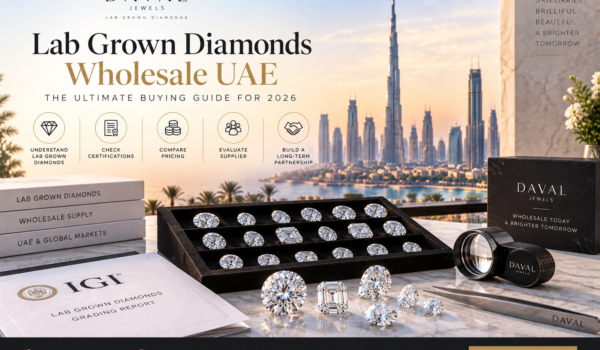
Lab Grown Diamonds Wholesale UAE: The Ultimate Buying Guide
Lab Grown Diamonds Wholesale UAE: The Ultimate Buying Guide The UAE traded a record 76.9 million carats
Lab Grown Diamond Suppliers Dubai: Essential 2026 Guide
Lab Grown Diamond Suppliers Dubai: Why UAE Jewellers Are Making the Switch The UAE traded 76.9 million
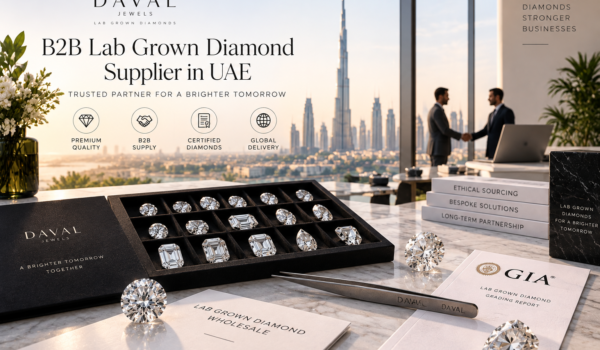
B2B Lab Grown Diamond Supplier UAE: A Complete Buying Guide
B2B Lab Grown Diamond Supplier UAE: A Complete Buying Guide UAE lab-grown diamond trade jumped 91.5%
Lab Grown Diamond Supplier UAE: 10 Things to Check
10 Things to Consider When Choosing a Lab-Grown Diamond Supplier in the UAE Choosing a lab grown diamond
NEW POSTS


September 17, 2026
Lab Grown Diamonds Wholesale UAE: The Ultimate Buying Guide

September 16, 2026