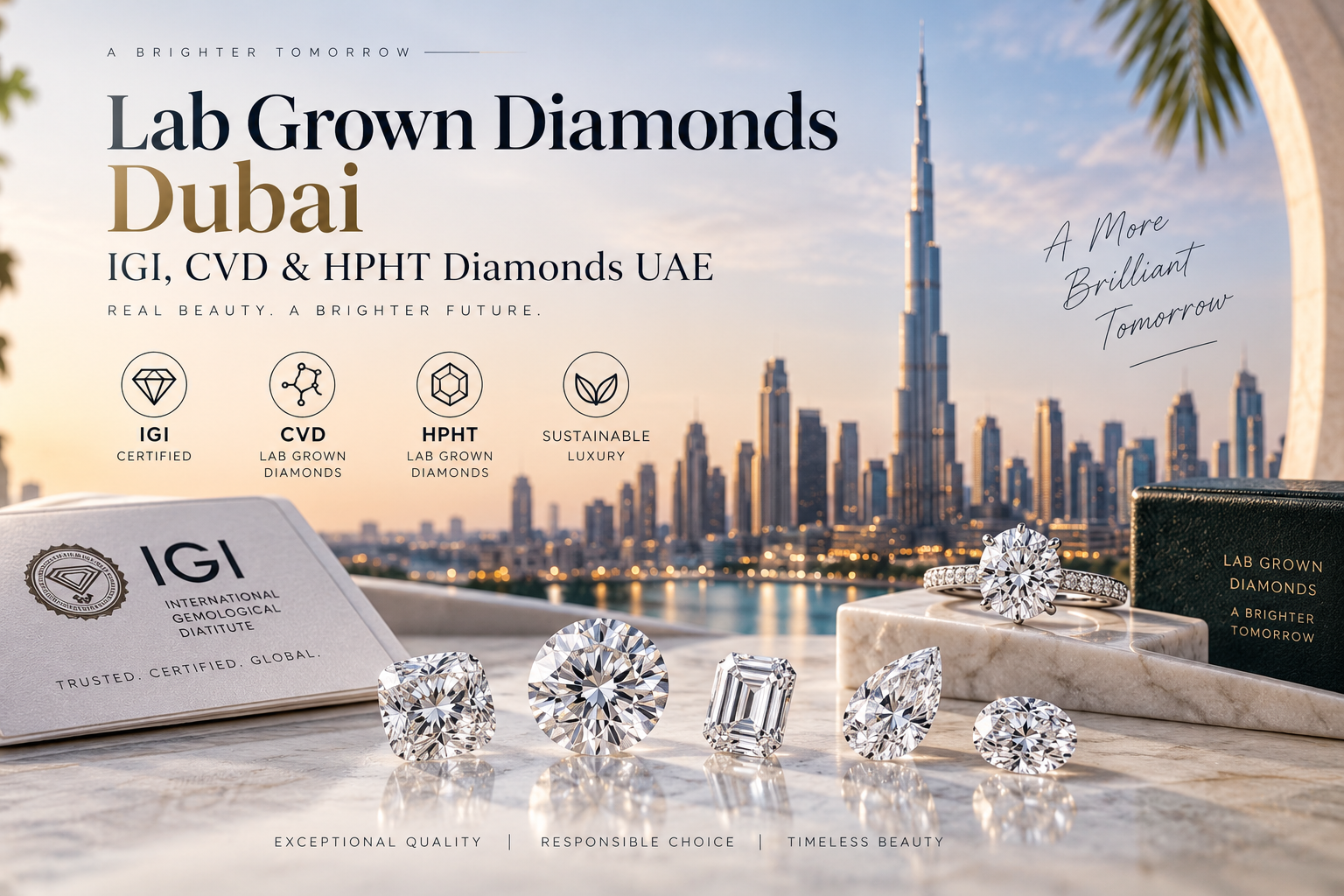
Lab Grown Diamonds Dubai | IGI, CVD & HPHT Diamonds UAE
Dubai’s diamond trade is going through its biggest shift in decades. In 2025, the UAE’s lab-grown diamond volume jumped 92% to a record 76.9 million carats, with trade value climbing to $1.3 billion — and the Dubai Multi Commodities Centre (DMCC) has since launched a dedicated Lab-Grown Diamond Division to keep pace with demand. For buyers, that growth translates into more choice, sharper pricing, and easier access to certified stones than ever before.
If you’re considering lab grown diamonds in Dubai — whether for an engagement ring, a jewellery upgrade, or a wholesale order — this guide walks through what these diamonds actually are, how IGI certification works, the difference between CVD and HPHT stones, and what to check before you buy.
What Are Lab Grown Diamonds?
A lab grown diamond is a real diamond. It has the same crystal structure, hardness, brilliance, and fire as a mined stone — the only difference is where it was formed. Instead of forming underground over billions of years, lab grown diamonds are created in controlled facilities that replicate the same high-pressure, high-temperature conditions found deep in the earth, compressed into a matter of weeks.
Because the chemistry and optical properties are identical, a lab grown diamond will not show up as “fake” on a jeweller’s loupe or standard testing equipment. Only specialised screening instruments, which look for trace growth patterns, can distinguish a lab grown stone from a natural one — which is exactly why independent certification matters so much when buying in the UAE market (more on that below).
Why Lab Grown Diamonds Are Booming in the UAE
Dubai has always been a global centre for diamond trading, and lab grown diamonds have found fertile ground here for a few clear reasons:
Significant savings. Lab grown stones typically cost 40–70% less than a natural diamond of comparable carat, cut, colour, and clarity, letting buyers size up without stretching budget.
Ethical sourcing. Buyers increasingly want a supply chain free of the sourcing concerns tied to some mined diamonds, and lab grown diamonds offer a transparent, traceable alternative.
Regional infrastructure. With DMCC’s new lab-grown vertical and established trading hubs like the Gold & Diamond Park, Dubai now has purpose-built infrastructure for grading, laser inscription, and trading lab grown stones locally.
Same 4Cs, same certification standards. Cut, colour, clarity, and carat are graded exactly the same way as natural diamonds, so shopping for one feels familiar even to first-time buyers.
CVD vs HPHT: Understanding the Two Growth Methods
Almost every lab grown diamond sold in Dubai is produced using one of two methods. Knowing the difference helps you understand what you’re actually paying for.
CVD (Chemical Vapour Deposition)
CVD diamonds are grown by placing a thin diamond seed inside a sealed chamber filled with carbon-rich gas. The gas is heated until carbon atoms separate and settle onto the seed layer by layer, gradually building a full crystal. CVD is currently the dominant method for premium jewellery-grade stones in the UAE because it offers:
- Strong, consistent colour grading (often D–F range)
- Excellent results in the 1–3 carat range most popular for engagement rings
- High clarity outcomes suited to solitaire and halo settings
HPHT (High Pressure, High Temperature)
HPHT diamonds are grown by subjecting a small diamond seed to intense heat and pressure, mimicking the natural conditions under the earth’s crust more directly. HPHT is often used to:
- Grow larger carat stones efficiently
- Treat and improve the colour of some CVD diamonds after initial growth
- Produce diamonds with a distinct crystal growth pattern that some buyers specifically request
Neither method produces a “better” diamond outright — the right choice depends on the carat size, colour, and budget you’re targeting. A good supplier will tell you plainly which method was used and let the certification confirm the rest.
Why IGI Certification Matters When Buying in Dubai
The International Gemological Institute (IGI) is the most widely used grading laboratory for lab grown diamonds worldwide, and it plays an especially central role in the UAE market. When you buy an IGI-certified lab grown diamond in Dubai, the report verifies:
- Carat weight, cut grade, colour, and clarity
- The growth method (CVD or HPHT)
- Confirmation that the stone is laboratory-grown, clearly stated on the report
- A unique report number, often laser-inscribed on the diamond’s girdle for lifetime traceability
Reputable suppliers only sell diamonds with clear laboratory documentation — from IGI or, for buyers who prefer it, GIA. Never rely on a jeweller’s verbal assurance alone. Always ask for the physical or digital grading report and match its report number to the inscription on the stone itself before finalising a purchase.
How to Choose the Right Lab Grown Diamond
Whether you’re buying loose or already have a setting in mind, work through these factors in order:
1. Set your budget first, then work backwards through the 4Cs. Lab grown pricing gives you more room to negotiate carat size, colour, or clarity without blowing past what you planned to spend.
2. Prioritise cut above the other Cs. A well-cut diamond reflects more light and looks more brilliant, even at a lower colour or clarity grade. This matters more for how a diamond actually looks on the hand than headline carat weight.
3. Decide between CVD and HPHT based on your target carat range. If you’re shopping in the 1–2 carat range for an engagement ring, CVD stones are usually the most cost-efficient with strong colour consistency. For larger statement pieces, HPHT stones are worth comparing.
4. Confirm certification before you commit. Insist on an IGI (or GIA) report, and check the inscription number under magnification if you’re viewing the stone in person.
5. Ask about return and upgrade policies. Established Dubai suppliers often allow trade-ins or upgrades as your budget or preferences change — useful if you’re buying now with plans to upgrade the centre stone later.
Buying Lab Grown Diamonds in Dubai: What to Look For in a Supplier
Dubai’s Gold & Diamond Park and DMCC-affiliated traders have made the city one of the most competitive markets in the world for lab grown diamonds, but not all sellers operate with the same transparency. Before buying, check that a supplier offers:
- A visible, browsable inventory of loose diamonds with report numbers attached to each stone
- IGI or GIA certification as standard, not an optional add-on
- Clear pricing by shape, carat, colour, and clarity — not vague “starting from” figures
- Support for custom jewellery, so you can move from a certified loose diamond to a finished ring or pendant with the same team
- Wholesale or bulk options if you’re a retailer or designer sourcing stones for a collection
Daval Jewels, based in the Gold Souk district of Deira, is one example of a Dubai supplier built around this model — offering a searchable collection of certified loose lab-grown diamonds with IGI and GIA reports, filterable by shape, carat, clarity, and colour, alongside custom jewellery and wholesale supply for retailers and designers across the UAE.
Frequently Asked Questions
Are lab grown diamonds real diamonds?
Yes. They share the same chemical composition, hardness, and optical properties as mined diamonds. The only difference is their origin.
Are lab grown diamonds certified the same way as natural diamonds?
Yes. Laboratories like IGI and GIA grade lab grown diamonds using the same 4Cs (carat, cut, colour, clarity) framework, with the report clearly stating the diamond is laboratory-grown.
Is CVD or HPHT better for an engagement ring?
Both are suitable. CVD is generally preferred for 1–3 carat engagement ring stones due to consistent colour grading, while HPHT is often chosen for larger carat weights or specific colour treatments.
How much cheaper are lab grown diamonds compared to natural diamonds in Dubai?
Buyers typically save 40–70% compared to a natural diamond of equivalent carat, cut, colour, and clarity.
Where can I buy certified loose lab grown diamonds in Dubai?
Established suppliers in areas like the Gold & Diamond Park and Deira’s Gold Souk district, such as Daval Jewels, offer IGI and GIA certified loose diamonds that can be viewed by shape, carat, and clarity before purchase or custom jewellery design.
Related posts
Lab Grown Diamond Wholesale Sourcing UAE: What Jewellery Businesses Need to Know
The UAE’s lab-grown diamond trade hit a record 76.9 million carats in 2025, up 91.5 percent on
Reliable Lab Grown Diamond Supplier UAE: A Wholesale Buyer’s Verification Checklist
Reliable Lab Grown Diamond Supplier UAE: A Wholesale Buyer’s Verification Checklist The UAE’s
Lab Grown Diamonds Wholesale UAE: The Ultimate Buying Guide
Lab Grown Diamonds Wholesale UAE: The Ultimate Buying Guide The UAE traded a record 76.9 million carats
Lab Grown Diamond Suppliers Dubai: Essential 2026 Guide
Lab Grown Diamond Suppliers Dubai: Why UAE Jewellers Are Making the Switch The UAE traded 76.9 million
B2B Lab Grown Diamond Supplier UAE: A Complete Buying Guide
B2B Lab Grown Diamond Supplier UAE: A Complete Buying Guide UAE lab-grown diamond trade jumped 91.5%
Lab Grown Diamond Supplier UAE: 10 Things to Check
10 Things to Consider When Choosing a Lab-Grown Diamond Supplier in the UAE Choosing a lab grown diamond
NEW POSTS


September 17, 2026
Lab Grown Diamonds Wholesale UAE: The Ultimate Buying Guide

September 16, 2026