Lab Grown Diamonds in Dubai: The Complete UAE Buyer’s Guide
- May 21, 2026
- 33
Lab Grown Diamonds in Dubai: The Complete UAE Buyer’s Guide
Lab grown diamonds have moved from a curiosity to a mainstream choice for UAE buyers — and Dubai, sitting at the centre of the global diamond trade, is one of the fastest-growing markets for them. If you’re considering a lab grown diamond for an engagement ring, an anniversary gift, or simply because the value is too good to ignore, this guide will walk you through everything that matters.
We’ve written it for buyers in Dubai, Abu Dhabi, Sharjah, and across the GCC who want a real, considered answer to the questions that matter: are lab grown diamonds real? How are they made? How do they compare to mined diamonds on price and quality? And how do you make sure you’re buying a genuinely certified, ethically sourced piece — not just a cheaper alternative dressed up in better marketing?
Let’s start with the basics.
What are lab grown diamonds?
A lab grown diamond is a real diamond. That’s the most important sentence in this guide, and the one most worth repeating.
Lab grown diamonds are pure crystallised carbon — identical in chemical composition, atomic structure, optical properties, and physical hardness to diamonds formed beneath the earth’s surface. They look the same. They behave the same under a loupe, under a microscope, and on a tester. The only difference is their origin: instead of forming over a billion years deep in the earth’s mantle, they’re grown in a controlled laboratory environment over a matter of weeks.
This is why the Federal Trade Commission in the United States, the Gem & Jewellery Export Promotion Council in India, and major laboratories like IGI and GIA all classify lab grown diamonds as diamonds — not as imitations, simulants, or “synthetic” stones in the colloquial sense. They are diamond, in every sense that matters.
If a jeweller tells you a lab grown diamond is “not a real diamond” — they’re either misinformed or they’re hoping you are. Both are reasons to walk away.
How are lab grown diamonds made?
There are two methods used to grow diamonds, and they produce slightly different results.
HPHT (High Pressure, High Temperature) recreates the conditions deep inside the earth. A small diamond seed is placed in a chamber, surrounded by a pure carbon source, and subjected to roughly 1,500°C of heat and pressures exceeding 1.5 million pounds per square inch. The carbon melts around the seed and crystallises onto it, growing a larger diamond over the course of about a week. HPHT is the older of the two methods and is widely used today, particularly for fancy yellow and brown diamonds.
CVD (Chemical Vapour Deposition) is the newer method and now produces the majority of lab grown diamonds on the market. A diamond seed is placed in a vacuum chamber filled with carbon-rich gases — usually methane and hydrogen. The chamber is heated, the gases ionise into a plasma, and pure carbon atoms rain down onto the seed, slowly building up the diamond layer by atomic layer. CVD typically produces the cleanest, whitest stones and is the preferred method for top-tier colourless lab grown diamonds.
Most reputable jewellers, including Daval Jewels, work with both CVD and HPHT diamonds, choosing whichever produces the best result for the cut, colour, and clarity grade required.
Are lab grown diamonds the same as cubic zirconia or moissanite?
No — and this is a critical distinction.
Cubic zirconia is zirconium dioxide. It is not a diamond. It is significantly softer than diamond (around 8 on the Mohs hardness scale versus 10 for diamond), it scratches easily, it clouds with wear, and its optical properties are obviously different to a trained eye. A cubic zirconia stone will visibly degrade within a few years of daily wear.
Moissanite is silicon carbide. It is not a diamond either. Moissanite is harder than cubic zirconia (around 9.25 Mohs) and far more durable, but its refractive index is higher than diamond, which gives it a recognisable “rainbow” fire that diamond doesn’t have. It’s a beautiful stone in its own right — but it is not a diamond.
A lab grown diamond, in contrast, is chemically and physically identical to a mined diamond. A jeweller’s loupe, a thermal tester, and even most professional gem identification equipment cannot distinguish a lab grown diamond from a mined one without specialised lab analysis. This is why all lab grown diamonds from reputable sellers carry a laser-inscribed certificate number on the girdle and an accompanying lab report.
Lab grown vs natural diamonds: what’s actually different?
Setting aside the chemistry, which is identical, the meaningful differences come down to three things: origin, price, and supply chain transparency.
Origin. A natural diamond formed in the earth’s mantle billions of years ago. A lab grown diamond formed in a chamber in the last few weeks. For some buyers, that geological history matters. For most, it doesn’t change how the diamond looks on a finger.
Price. This is where the difference is dramatic. A lab grown diamond of equivalent carat, colour, clarity, and cut typically costs 60–80% less than its mined equivalent. A 1-carat round brilliant lab grown diamond with VVS clarity and E–F colour might retail in Dubai for a fraction of what the same mined stone would. The savings get larger as the stones get bigger — at 3 carats and above, the gap can be enormous.
Supply chain. Lab grown diamonds have a fully traceable supply chain. You know exactly where the stone was grown, when, and by which producer. The mined diamond industry has worked hard since the Kimberley Process to address conflict diamonds, but full traceability remains harder — and the environmental footprint of large-scale diamond mining is substantial. Lab grown diamonds typically use less water and disturb less land, though their carbon footprint depends on the energy mix of the facility where they’re grown.
For a full side-by-side breakdown — including specific price comparisons in AED and the resale value question — see our detailed lab grown vs natural diamonds comparison (link to article in week 2).
The 4Cs of lab grown diamonds
Lab grown diamonds are graded on exactly the same 4Cs as mined diamonds: Cut, Colour, Clarity, and Carat weight.
Cut is the most important of the four because it determines how the diamond returns light to your eye. A poorly cut diamond — even at high colour and clarity — will look dull. A well-cut diamond at lower colour and clarity will still sparkle beautifully. Look for diamonds graded “Excellent” or “Ideal” cut.
Colour is graded on a scale from D (completely colourless) to Z (light yellow). For lab grown diamonds, the most popular grades are D, E, and F — all classified as “colourless” or “near-colourless”. At G–H you start to see very faint warmth in larger stones. Below J, the warmth becomes visible to the naked eye in most settings.
Clarity measures internal inclusions and surface blemishes, on a scale from FL (flawless) down to I3 (heavily included). For most engagement ring stones, VS1 or VS2 represents the sweet spot — inclusions are invisible to the naked eye, and the price doesn’t carry the premium of higher VVS or IF grades. At Daval, our standard catalogue sits at VVS2 — a step above the typical retail bar.
Carat is the weight of the diamond, not its size. A 1-carat round brilliant typically measures around 6.5mm across; an oval of the same carat will appear larger because it spreads across more surface area. When you’re choosing a diamond, think about visual size and shape together — carat alone doesn’t tell the whole story.
We cover each of these in more depth in our 4Cs explained guide (link to month 3 article).
Certification: IGI, GIA, and what to look for
Every lab grown diamond worth buying comes with a certificate from an independent gemmological laboratory. The certificate is your proof of what you’re buying.
IGI (International Gemmological Institute) is currently the most common certification for lab grown diamonds globally, with major lab facilities in Mumbai, Antwerp, and Hong Kong. IGI grades the full 4Cs and laser-inscribes the report number onto the diamond’s girdle so you can match the stone to its report at any time.
GIA (Gemmological Institute of America) is the most respected name in the diamond industry, particularly for natural diamonds. GIA also certifies lab grown diamonds, though its lab grown grading uses slightly different terminology in some grades. GIA certificates carry a premium in resale and trade contexts.
For a buyer in the UAE, either certificate is a strong indicator of authenticity and grade accuracy. What matters is that the certificate exists, that the report number on the certificate matches the laser inscription on the diamond, and that the seller can produce both. If a seller can’t show you the lab report, don’t buy the diamond.
We go deeper on this in our IGI vs GIA certification guide (link to month 3 article).
Why lab grown diamonds are growing fast in the UAE
The UAE has been one of the fastest-adopting markets for lab grown diamonds in the world, and the reasons make sense when you look at the demographics.
UAE buyers — particularly under-35 buyers — are highly educated, globally aware, and value-conscious in the right way. They’re not looking for the cheapest option. They’re looking for the best value for the price they pay. A lab grown diamond that visually matches a stone costing three times more is exactly that kind of value.
Dubai’s NRI (Non-Resident Indian) community has also accelerated the shift. Lab grown diamonds are manufactured at scale in India — the country produces the majority of the world’s lab grown diamonds — and Indian buyers in Dubai often have family connections to the industry. Familiarity has bred confidence.
And the Gold Souk, historically known for gold by weight and traditionally cut stones, has been quietly modernising. Several Souk-based jewellers, Daval Jewels included, now stock lab grown diamonds exclusively or alongside their traditional inventory. For buyers, this means you no longer have to choose between the centuries-old trust of the Souk and the modern value of lab grown — you can have both, in the same showroom visit.
How lab grown diamond prices work in the UAE
Lab grown diamond pricing in Dubai is driven by the same factors as elsewhere — the 4Cs, the shape, and current supply — but UAE buyers benefit from a few structural advantages.
No VAT-equivalent margins. UAE customs duties on loose diamonds are minimal, which keeps wholesale pricing tight.
Direct India-UAE supply lines. With manufacturing largely in India and a substantial trade corridor into the UAE, intermediary margins are thinner than in many Western markets.
A competitive Gold Souk environment. Multiple jewellers operating within a small physical area drive pricing toward fair market levels.
That said, lab grown diamond prices have been moving downward globally for several years as manufacturing capacity has scaled. A 1-carat lab grown diamond that cost X in 2022 likely costs significantly less today at the same specifications. This is good news for buyers — but it does raise questions about resale value, which we address in a separate article on the resale value of lab grown diamonds (link to month 7 article).
At Daval, we don’t publish prices online because pricing varies by stone, certification, and any custom work involved. The best way to get current pricing is to message us on WhatsApp at +971 58 621 8338 with the carat range and style you’re considering, and we’ll send you live options with full certifications and AED prices.
How to choose your first lab grown diamond
If you’re buying your first lab grown diamond, here’s the order we recommend thinking about your choice:
1. Start with the shape. Round brilliant is the most classic and the most brilliant; oval gives you a larger visual size at the same carat weight; emerald and asscher cuts have a more architectural, vintage feel; princess and radiant balance sparkle with a modern silhouette. Choose the shape first because it will shape everything else.
2. Set your carat target. Decide on a range — for example, “between 1 and 1.5 carats” — rather than a single number. Carat weight directly drives price, and being flexible by even 10% can give you significantly better value at the same overall budget.
3. Prioritise cut, then colour, then clarity. A well-cut diamond at G colour, VS2 clarity will outperform a poorly cut diamond at D colour, IF clarity every time. If you have to compromise, compromise on clarity before colour, and never on cut.
4. Get the certificate. Insist on IGI or GIA certification, and make sure the report number is laser-inscribed on the diamond. Without this, you have no independent verification of what you’re buying.
5. Choose your setting last. Once you know the centre stone, the setting decisions — solitaire, halo, three-stone, cathedral — follow naturally. Most of our customers find this is the most fun part.
For a complete walk-through of every step from budget to proposal, see our Engagement Ring Buying Guide Dubai 2026 (link to article 2).
Where to buy lab grown diamonds in Dubai
You have three main options for buying lab grown diamonds in Dubai.
Online-only retailers offer the widest selection and often the most competitive prices, but you’re buying a high-value piece without seeing it in person. For first-time buyers, this can be uncomfortable — and returning a piece across international shipping is rarely as straightforward as the websites suggest.
Mall-based jewellery chains offer the convenience of in-person viewing in familiar locations, but their pricing typically reflects retail rent, brand marketing, and multiple layers of margin. The same stone can cost significantly more in a mall than at a specialist.
The Gold Souk specialists sit in the middle: physical showrooms where you can see and try every piece, with pricing that reflects the Souk’s competitive trade environment rather than mall-rent overheads. For most UAE buyers — particularly those investing in an engagement ring or significant gift — this is the most balanced option.
Daval Jewels is at Shop 12, Hind Plaza 7, Gold Souk District, Deira, Dubai. You can visit us seven days a week from 10am to 9pm, or book a private appointment through our virtual tour page.
Frequently asked questions
Are lab grown diamonds real diamonds? Yes. Lab grown diamonds are chemically, physically, and optically identical to mined diamonds. They are real diamonds in every meaningful sense, and are classified as diamonds by every major gemmological authority worldwide.
Do lab grown diamonds test as diamonds on a diamond tester? Yes. Standard thermal and electrical diamond testers cannot distinguish lab grown diamonds from mined diamonds, because the underlying material is identical. Specialised equipment in a gem lab is required to identify the growth method.
Will lab grown diamonds hold their value? Lab grown diamond resale values have historically been lower than mined diamonds, in part because the market is younger and prices have been falling as production scales. We cover this honestly in our resale value article. The honest framing: buy a lab grown diamond for what it offers you today — beauty, value, and ethical sourcing — not as a financial investment.
Are lab grown diamonds ethical? Lab grown diamonds avoid the geopolitical and human rights complexities that have historically affected the mined diamond industry. They also use less water and disturb no land. Their carbon footprint depends on the energy used to grow them, which varies by producer. For most buyers, the ethical advantages of lab grown diamonds are substantial.
Can I get a lab grown diamond certified by IGI or GIA? Yes. All Daval Jewels lab grown diamonds come with IGI or GIA certification by default, with the report number laser-inscribed on the diamond’s girdle for verification.
What size lab grown diamond can I afford in Dubai? With the same budget that buys a 0.5-carat mined diamond, you can typically buy a 1.5–2 carat lab grown diamond of equivalent or better grade. The exact size depends on the 4Cs you prioritise. Message us on WhatsApp with your budget and we’ll send a few real options.
Visit our Gold Souk showroom
The best way to understand lab grown diamonds is to see them. We invite you to visit our showroom in the Deira Gold Souk, where you can examine certified lab grown diamonds across every shape, size, and grade — alongside the lab reports that document them.
Daval Jewels Shop 12, Hind Plaza 7, Gold Souk District, Deira, Dubai, UAE Open 7 days a week, 10am — 9pm
WhatsApp us to book a private viewing or to request specific stones in your range. We respond within an hour during business hours.
Browse our collection | Request a Quote | Take a Virtual Tour
Related posts
Certified Lab Grown Diamond Supplier UAE: What B2B Buyers Should Check
The UAE’s lab-grown diamond trade just had its biggest year on record. Volumes hit 76.9 million
Local Lab Grown Diamond Supplier UAE: Why Proximity Pays Off for Buyers
Dubai’s DMCC recently created a dedicated Lab-Grown Diamond Vertical after the UAE’s trade
Lab Grown Diamond Wholesale Sourcing UAE: What Jewellery Businesses Need to Know
The UAE’s lab-grown diamond trade hit a record 76.9 million carats in 2025, up 91.5 percent on
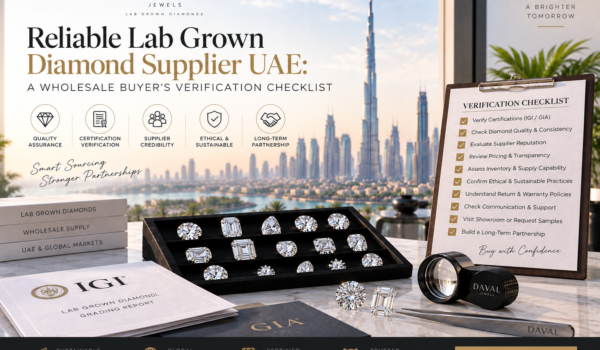
Reliable Lab Grown Diamond Supplier UAE: A Wholesale Buyer’s Verification Checklist
Reliable Lab Grown Diamond Supplier UAE: A Wholesale Buyer’s Verification Checklist The UAE’s
Lab Grown Diamonds Wholesale UAE: The Ultimate Buying Guide
Lab Grown Diamonds Wholesale UAE: The Ultimate Buying Guide The UAE traded a record 76.9 million carats
Lab Grown Diamond Suppliers Dubai: Essential 2026 Guide
Lab Grown Diamond Suppliers Dubai: Why UAE Jewellers Are Making the Switch The UAE traded 76.9 million
Categories
NEW POSTS

Certified Lab Grown Diamond Supplier UAE: What B2B Buyers Should Check